
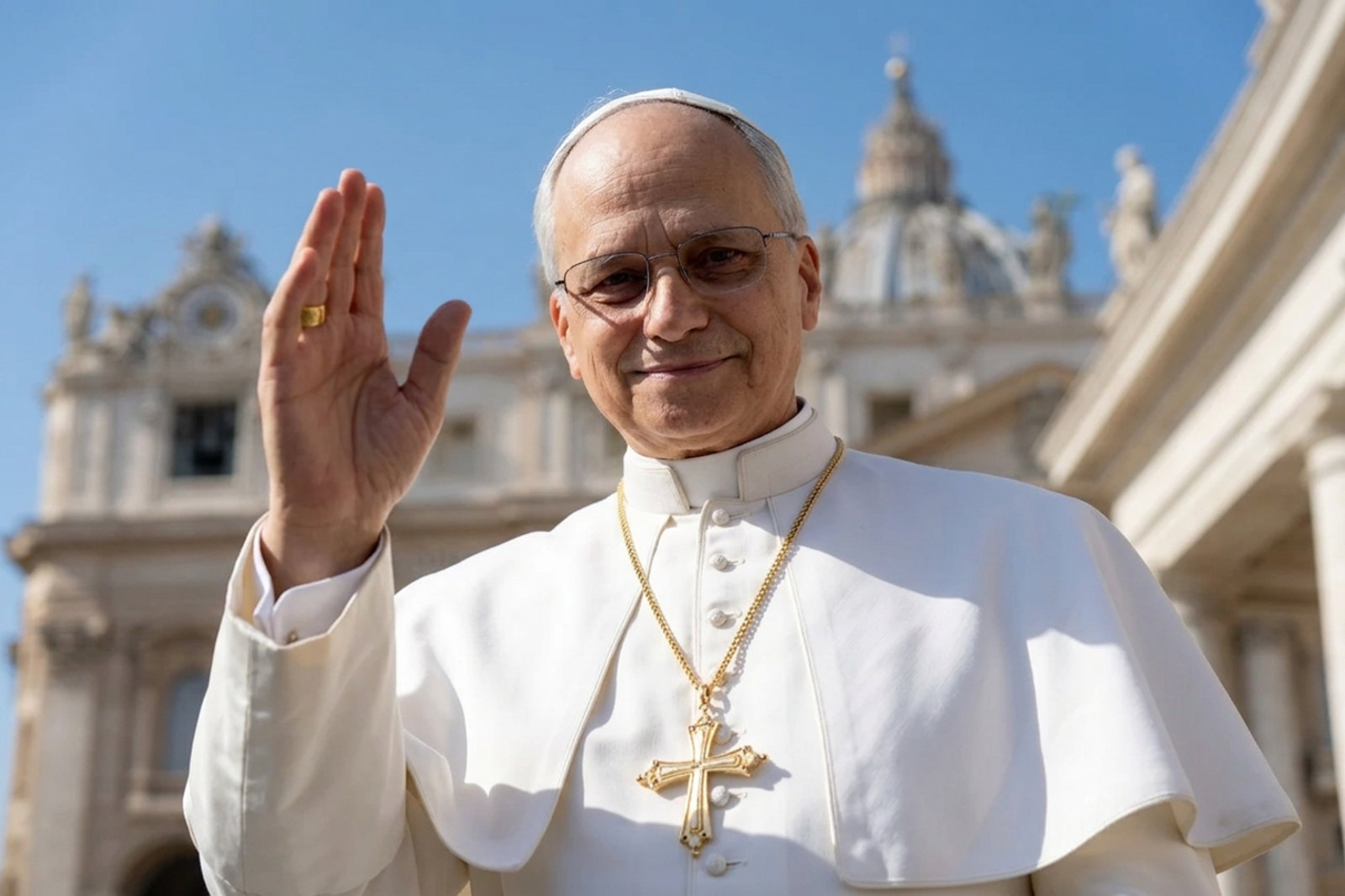
Cristian Saracco, Nicholas Ind and Giuseppe Cavallo on Pope Leo XIV’s encyclical, Magnifica Humanitas, and what it means in the era of “AI”
Pope Leo XIV’s encyclical, Magnifica Humanitas, puts the moral responsibility of leaders at the centre of the debate on Artificial Intelligence.
The very title of the encyclical—Latin for Magnificent Humanity—is a clear push-back on the techno-evangelism that largely ignores notions of morality and human dignity. However, the Pope’s argument is not simply naysaying. It is a nuanced appeal to safeguard the ‘grandeur of humanity’ and an expression of hope.
We review the encyclical through the prism of ambidextrous and conscientious leadership and consider the moral implications of it for businesses and brands.
- Magnifica Humanitas as a mirror for civilization
- Babel or Jerusalem
- AI takes the face of those who design, finance, regulate and use it
- When the builders admit they cannot govern the tower
- The human consequences of artificial intelligence
- From technological capacity to moral authority
- Protecting what must remain, transforming what must change
- Human core, transformation, tension and brand as meaning
- Conscience as the place from which an organisation decides
- The algorithm did not decide alone
- Remaining deeply human in the way we design, govern and lead
- From better software to better judgement
Magnifica Humanitas as a mirror for civilization
Magnifica Humanitas addresses the use of technology as the mirror in which a civilization is forced to look at itself.
Humanity, created by God in all its grandeur, is today facing a pivotal choice: either to construct a new Tower of Babel or to build the city in which God and humanity dwell together.1
As the sub-title of the encyclical suggests—On Safeguarding the Human Person in the Time of Artificial Intelligence—Pope Leo XIV’s central concern is the human being standing before a new form of power and asking, with some urgency:
What kind of world are we building, and what kind of people are we becoming while we build it?
That is why the encyclical avoids the two laziest temptations of our time. It neither blesses technology with the cheerful innocence of a child unwrapping a new device, nor condemns it with the theatrical horror of someone who believes electricity was already a step too far. Its argument is more demanding and more useful:
Technology is neither salvation nor damnation. It is an expression of human intention, economic power, cultural imagination and moral choice.2
AI, then, is not seen merely as an instrument. It is a civilizational accelerator. It can help heal, educate, connect, discover, protect, and create. It can also concentrate power, manipulate truth, replace judgement, weaken freedom, deepen inequality, and turn human beings into data points in systems that no longer know how to see a face.
The question, therefore, is not whether we should accept or reject AI. That is far too simplistic. The right questions would be: what kind of instrument are we setting in motion, who controls it, who is involved, who is affected, and whether we are still able to distinguish between these situations?
Babel or Jerusalem
One of the most powerful images in Magnifica Humanitas is the contrast between Babel and Jerusalem.
Babel is not presented simply as technological arrogance. It is the temptation to build a future based on uniformity, control, and self-sufficiency. It is a city of technical brilliance and spiritual poverty; a structure that rises impressively while the human being underneath it becomes smaller, more measurable, more manageable and, eventually, more disposable.
Jerusalem, by contrast, is not nostalgia nor a pious retreat into imagined safer times. Jerusalem is the shared work of rebuilding a common life. It is plural, communal, vulnerable, practical, and hopeful. It does not deny complexity. It asks each person, institution, and community to take responsibility for its own stretch of wall.
That distinction gives the encyclical its real force. The challenge of the AI age is not mainly technical. It is architectural in the deepest sense:
Are we building a system of domination or a house of communion? Are we designing a world where power rises above people, or one where power is disciplined by dignity?
The warning is clear. When progress is detached from the person, it becomes a tower. Tall, impressive, and waiting for its own collapse.
The non-neutrality of technology
One of the encyclical’s strongest insights is that technology is not neutral in any meaningful social sense.
In the abstract, technology in and of itself is not a solution to humanity’s problems, just as it is not inherently evil. In practice, however, technology is never neutral, because it takes on the characteristics of those who devise, finance, regulate, and use it.3
Of course, technology may appear neutral when described in abstraction, but in reality, it comes designed, funded, owned, governed, narrated, and deployed. It embodies assumptions about efficiency, value, knowledge, risk, and the human person. It privileges certain behaviours and makes others invisible. It rewards what can be measured and often neglects what should be honoured.
This is especially true of AI, which does not merely process information; increasingly it shapes access, visibility, credibility, and opportunity. It influences what people see, how organizations decide, how citizens debate, how workers are evaluated, how consumers are guided, and how societies imagine what is possible.
The encyclical, therefore, moves the conversation beyond ethics as a polite appendix to innovation. It asks for discernment before deployment, governance before dependence, and responsibility before scale.
When the builders admit they cannot govern the tower
This concern is not merely theological or philosophical. It has also begun to emerge, with striking honesty, from within the technology industry itself.
Among those invited to the launch of the encyclical, at the Vatican was Christopher Olah, co-founder of Anthropic, one of the world’s leading artificial intelligence research companies. His presence alongside cardinals and theologians was unusual in itself. What he said was more so, combining candour and intellectual honesty of a kind rarely heard from within the technology industry.
Olah told the Pope—and, through him, all of us—two things at once:
- that the organizations building this technology are inherently incapable of fully governing themselves, because their incentives, commercial, geopolitical, and personal, are not aligned with the protection of humanity;
- that the technology itself has moved beyond full comprehension even by those who create it, showing signs of inner states that resemble emotion, identity and introspection, whose meaning remains genuinely unknown.
Taken together, the message is troubling: the people building AI cannot be trusted to regulate themselves, and they cannot fully account for what they are building. Both conditions point to the same conclusion: external voices are needed, those whose priority is not profit or power, and whose concern is the human person as an end in itself.
This is precisely where Magnifica Humanitas becomes more than a religious document addressed to believers. It becomes a public act of moral authority. It reminds business, politics, and civil society that the governance of AI cannot be left only to those who build it, sell it or race to control it.
Truth, work and freedom
The encyclical becomes especially concrete when it addresses three areas: truth, work, and freedom.
Truth is treated as a common good: a vital idea in an age where public life is increasingly shaped by algorithmic distribution, synthetic content, emotional manipulation, and the collapse of shared reference points. Democracy cannot survive on noise alone. It requires trust, verification, accountability, and a minimum loyalty to reality. Without that, public debate becomes theatre, citizenship becomes performance and truth becomes just another item in the content calendar.
Work is treated not as a cost to be optimized away, but as a fundamental expression of human dignity. AI may improve productivity, reduce dangerous tasks, and augment human capability. Yet it may also produce displacement, surveillance, deskilling, and new forms of precariousness. The moral question is not whether AI makes work more efficient, but whether it makes economic life more human.
Freedom is treated as something more fragile than we like to admit. Digital systems do not only offer choice; they can also predict, frame, stimulate and monetize desire. Such systems can create dependency while calling it engagement. They can narrow imagination while offering endless options. They can turn attention into raw material and behaviour into inventory. The encyclical understands that the loss of freedom in the digital age may not arrive as a dramatic act of oppression, but as convenience, personalization and a thousand tiny permissions granted without thought.
The real issue: power
Technological power thus takes on an unprecedented, predominantly ‘private’ aspect, which makes it even more challenging to discern, govern and direct such power toward the common good.4
Beneath all these themes lies the question of power5—above authority.
AI is developing in a world where some of the most decisive technological infrastructures are controlled by private actors whose scale, capital and influence exceed the capacity of many public institutions. This does not make them villains by definition (caricature is satisfying, but usually lazy). It means, however, that governance must be taken seriously.
The encyclical asks who holds technological power, how it is exercised, whom it benefits and who is left exposed? This matters because AI does not operate in a vacuum. It enters societies already marked by inequality, geopolitical tension, ecological fragility, institutional mistrust, and economic concentration. In such a context, technology can either help repair the social fabric or pull harder at its loose threads.
This is why regulation is necessary but insufficient. Law can set limits, define responsibilities, and reduce abuse. Yet the deeper task is cultural and moral. A society must decide what it considers progress.
If progress means only more power, more speed, more prediction, more automation and more extraction, Babel has already won the planning permission.
Magnifica Humanitas and ambidexterity
The encyclical also invites a powerful reading through the idea of ambidexterity.
Ambidexterity is not a fashionable managerial label. It is the discipline of sustaining what must remain while transforming what needs to change. It is the capacity to operate with two complementary forms of intelligence: one that protects continuity, identity, and coherence; and another that explores, adapts, and learns. The point is not to choose between stability and change, but to govern the tension between them without allowing either to destroy the other:
true fulfilment is not achieved by eliminating weakness but through harmonious growth. It is found where freedom and responsibility are intertwined with mutual care and true solidarity, and where progress is measured by the dignity of each person and the good of all peoples.6
The encyclical does not ask humanity to reject technological transformation. Nor does it invite us to surrender to innovation as if every new capability deserved moral applause simply because it is new. Instead, it proposes a profoundly ambidextrous posture: embrace the possibilities of AI while protecting the permanent dignity of the human person.
In business terms, this is the difference between transformation with a centre and transformation as corporate vertigo. Many organizations today confuse movement with progress. They adopt every tool, platform, and acronym with the anxious enthusiasm of someone buying gym equipment in January. Yet the question remains: what is being strengthened, and what is being lost?
An ambidextrous reading of Magnifica Humanitas would suggest four strategic principles.
- Protect the human core. The more powerful technology becomes, the more important it is to define what cannot be delegated: conscience, moral judgement, compassion, responsibility, care, wisdom, and the ability to recognize another person as more than a profile, a segment, or a predictive pattern.
- Transform what no longer serves. Defending the human does not mean defending every existing institution, habit, or business model. Some ways of working, governing, educating and communicating are already exhausted. The encyclical’s humanism is not decorative conservatism. It is a call to rebuild.
- Design with these tensions in mind. AI creates real tensions between efficiency and dignity, innovation, and justice, personalization, and privacy, automation, and employment, scale, and accountability. These tensions will not disappear simply because someone includes the term ‘ethical AI’ in a presentation; on the contrary, they must be integrated into the design of governance mechanisms, culture, leadership, and decision-making.
- Using brand as a system of meaning. Brands can play a central role in an ambidextrous strategy by linking identity with evolution. A brand, understood in its broadest sense, is a system of meaning that helps organizations decide what to retain, what to evolve, and how promises are translated into action.
This makes the encyclical surprisingly relevant for business and brand strategy. It reminds us that the great issue of the AI age is not technological but meaningful adoption.
The question is whether companies are using AI in a way that builds trust, enhances human judgement, empowers people to contribute, and helps build a future worth living in.
Magnifica Humanitas and conscience in business, brands and leadership
There is an even deeper connection between Magnifica Humanitas and the idea of conscience in business, brands, and leadership.
Conscience in business is not an ornamental virtue. It is not a soft paragraph in a sustainability report, nor the moral fragrance sprayed over quarterly targets. Conscience is the place from which an organization decides. It is the inner criterion that shapes what a company sees, what it ignores, what it considers acceptable and what it refuses to become.
That idea sits remarkably close to the encyclical’s core. Magnifica Humanitas asks humanity to examine not only what it can build, but from where it is building. The same applies to companies. The decisive question is not only what technologies they adopt, what markets they enter or what messages they communicate. The decisive question is: how do we understand human beings?
The view of branding as a strategic platform for transforming companies and businesses through value, results and positive impact is highly relevant here. It places brand where it belongs: in the operating logic of the organization. A brand with conscience must shape decisions, experiences, relationships, culture, and the allocation of resources.
A conscientious brand is not merely one that appears kind, ethical or sustainable. It is one whose conduct reflects humanistic, responsible, and socially meaningful behaviour. It understands that brands are co-created with stakeholders and that business success cannot be separated from the quality of the impact produced in society.
This matters enormously in the age of AI.
AI will make it easier for brands to speak, publish, simulate, personalize, and persuade. It will also make it easier for them to become hollow. A brand may soon generate endless content, instant campaigns, synthetic service interactions, and perfectly optimized messages while becoming less truthful, less coherent, and less worthy of trust. That is the great paradox: machines may help brands sound more human while organizations behave less humanely.
Conscience is the antidote.
A conscientious business asks whether AI strengthens or weakens the company’s purpose. A conscientious brand asks whether automation protects or erodes trust. A conscientious leader asks whether efficiency is being used to liberate human potential or merely to extract more from fewer people.
Leadership, in this context, becomes the art of governing tensions. It must hold performance and responsibility together. It must protect margins without sacrificing meaning. It must innovate without surrendering judgement. It must use AI without allowing it to become the hidden author of corporate behaviour.
This is not naïve idealism. It is hard realism with a human face. Companies that lose trust, coherence and legitimacy eventually pay for it. Sometimes financially. Sometimes culturally. Often both. The invoice may arrive late, but it usually arrives with interest.
From artificial intelligence to human responsibility
The great merit of Magnifica Humanitas is that it refuses to let us hide behind the machine.
While managers laud the virtues of AI, it can also be used as a scapegoat: ‘The algorithm decided.’ However, this ignores the responsibility of those who design and use AI. In many organizations, technology is already used as a way of avoiding judgement. Dashboards replace conversations. Metrics replace meaning. Automation replaces accountability. The result may look efficient, but it can become morally anæmic.
The danger is not only that machines become more intelligent. It is that humans become more willing to outsource the burden of wisdom and to deny the consequences of their actions.
A business reading of the encyclical would therefore lead to a practical conclusion: AI must be governed as part of strategy, culture, and brand, not merely as a technical implementation. It should be assessed by its contribution to value, results, and impact; by its effect on trust, dignity, work, truth, and freedom; and by its ability to support rather than replace human judgement.
The most pertinent question for leaders is not ‘To what extent can we use AI?’ but ‘What kind of organization do we become when we use it in a certain way?’
The human future of strategy
Magnifica Humanitas is ultimately a document about the future. It understands that the future is built by decisions, limits, institutions, relationships, courage, and care.
It is here that his message touches upon the essence of ambidexterity and conscience. The future requires change, but not any change. It requires continuity, but not any continuity. Some things must evolve quickly; others must be protected precisely because they are slow, fragile, and irreplaceable.
Human dignity is one of them. Trust is another. So are truth, work, freedom, community, responsibility, and peace.
In an age of AI, the most strategic act may be to remain deeply human in the way we design, govern, decide, measure, lead, and communicate.
That is the real challenge for institutions, businesses, brands, and leaders. It is about building systems in which awareness is present from the outset, giving them greater meaning and making them a shared space.
In the age of artificial intelligence, in which human dignity risks being eclipsed by new forms of dehumanization, we have the urgent duty to remain deeply human, lovingly safeguarding that magnificent humanity which has been given to us and revealed in fullness in Christ, and which no machine will ever be able to replace in its splendour.7
Will Pope Leo’s encyclical have an impact? There will always be those who reject the idea that moral judgement has any meaningful role to play in business. For them, the pursuit of efficiency trumps whatever qualms may arise about its negative effects on humanity. Yet it would be a hollowed-out world if efficiency always prevailed over creativity, care, and the nurturing of human intelligence.
Pope Leo’s essential argument is that we must not lose what makes us magnificent humans; that leaders must be wise if we are to reap the benefits of AI while sustaining human dignity. Businesses can play a decisive part in this, but only if they recognize the opportunity to act as moral influencers alongside their commercial imperatives.
The Pope makes a compelling case for why they should do so, and his unique global moral authority makes him powerfully persuasive. Yet, as he notes, achieving the future he envisages is down to all of us:
to stop building Babel with better software, to rebuild Jerusalem with better judgement, and to become “weavers of hope in our world”.
Footnotes
1. HH Pope Leo XIV: ‘Encyclical Letter, Magnifica Humanitas, of His Holiness Pope Leo XIV on Safeguarding the Human Person In the Time of Artificial Intelligence’, Encylicals. Vatican City: the Holy See 2026, introduction, §1: Pope Leo XIV frames the AI age as a civilizational choice between building a new Babel or a city where God and humanity may dwell together.
2. Ethics is the reflective framework through which we judge what is right; moral is the lived orientation of conscience and behaviour. For Catholics, moral implies responding to God’s call to act according to truth, human dignity, love, justice, and the Gospel.
3. HH Pope Leo XIV, op. cit. Introduction, §9: Pope Leo XIV states that technology is neither a solution in itself nor evil in itself, but becomes morally charged through those who design, finance, regulate, and use it.
4. Ibid. Introduction, §5: Pope Leo XIV warns that technological power is increasingly concentrated in private, transnational actors whose capacity may exceed that of many governments.
5. Power is the capacity to make others act; authority is the legitimacy that makes others willing to follow. Power can impose obedience; authority earns recognition
6. HH Pope Leo XIV, op. cit. Introduction, §12: Pope Leo XIV argues that true fulfilment does not come from eliminating human fragility, but from harmonious growth where freedom, responsibility, care, and solidarity are held together.
7. Ibid. Introduction, §15: Pope Leo XIV calls humanity to remain deeply human in the age of AI, insisting that no machine can replace the splendour of the human person.
Originally published on the Medinge Group website. Used with the express permission of the authors.